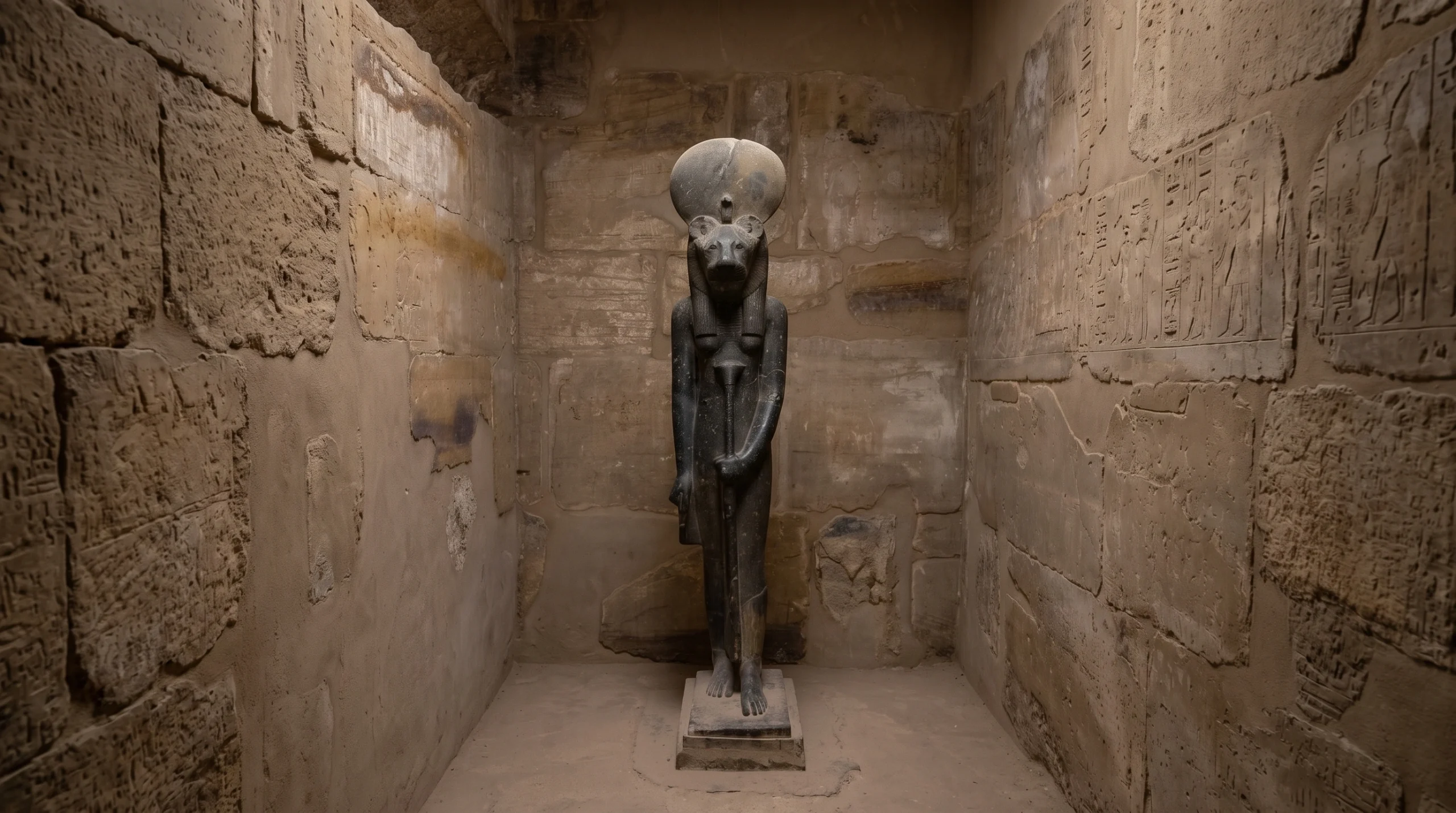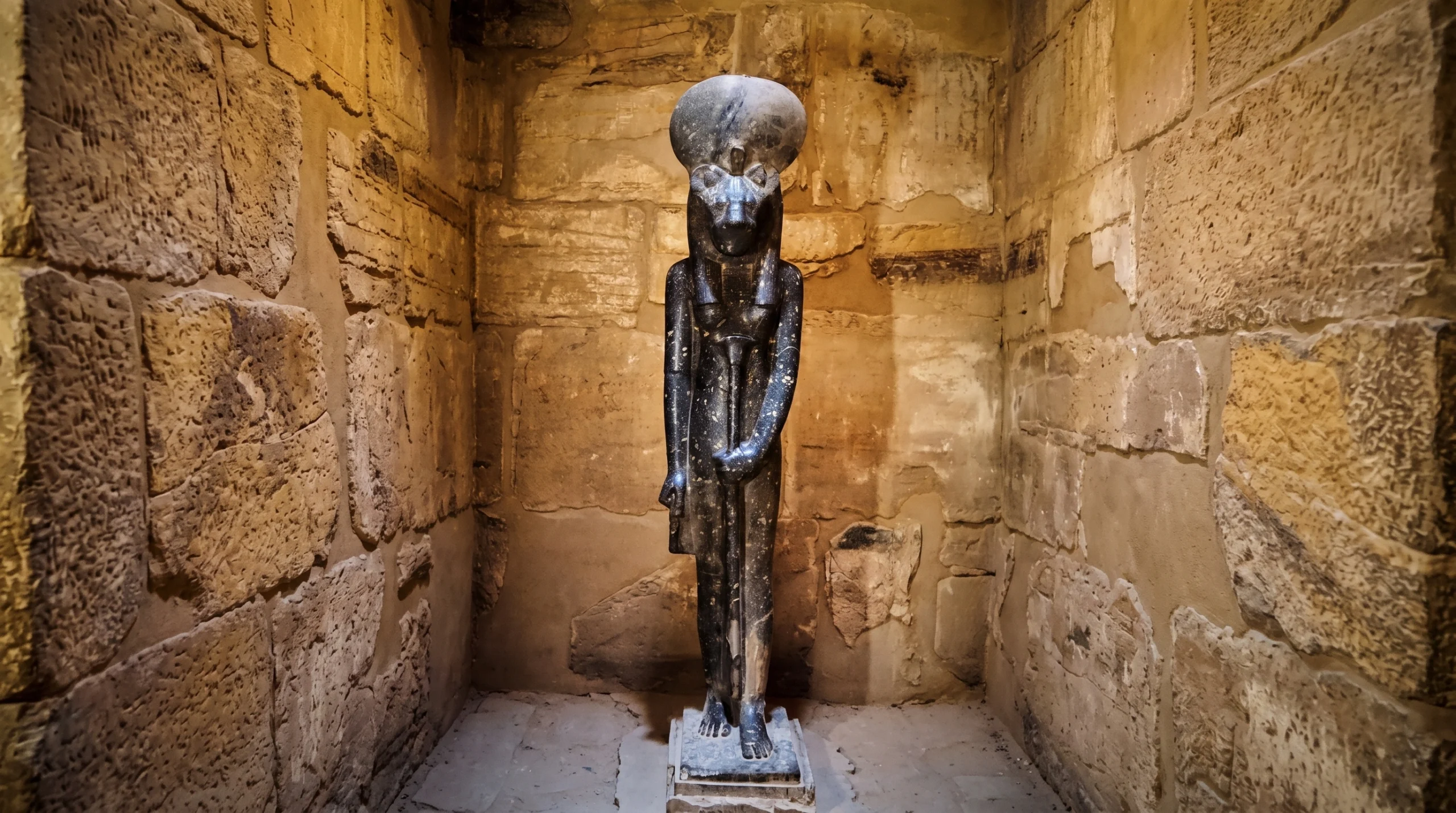
Sekhmet Karnak is a lioness headed goddess who still stands in a small dark chapel inside the Temple of Ptah, in the north of the Amun precinct.
- Who she is: daughter of Ra, goddess of war, plague and healing
- Her name: from sekhem, power. “The Powerful One”
- Where she is: the Temple of Ptah, a small temple most visitors walk past
- What you see: a standing statue in dark granite, lit by a slot in the roof
- Why it is different: she is still in the chapel built for her, not in a museum case
Most people come to Karnak for the Hypostyle Hall and leave without knowing she is there.
Who Sekhmet was
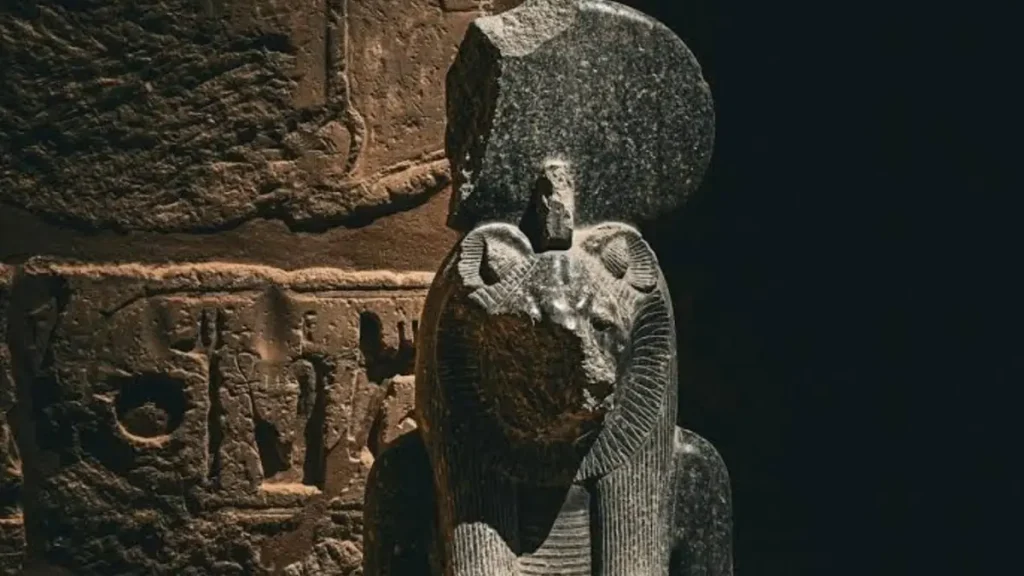
Sekhmet is a woman’s body with a lioness’s head, usually crowned with a sun disc. Her name comes from the word sekhem, meaning power or might, so it reads roughly as “the Powerful One”. Egyptian names are rarely accidental, and hers is a warning.
She was the daughter of Ra, and in several texts she is his Eye: the part of the sun god sent out to do what the sun god cannot do himself. She was a goddess of war and of plague. She was also, in the same breath, a goddess of healing, and her priesthood was closely tied to Egyptian medicine.
At Memphis she formed a triad with Ptah, the creator god and patron of craftsmen, and their son Nefertum. That relationship is the reason she is at Karnak at all.
Sekhmet Karnak: where she stands in the complex
Karnak is not one temple. It is a walled complex of temples, chapels, courts and pylons built, extended and rebuilt over roughly two thousand years. Within this vast complex, Sekhmet Karnak is one of the remarkable features that visitors can discover, alongside the first pylon, the Great Court, the Hypostyle Hall and the sacred lake.
The Temple of Ptah sits north of that route, near the northern wall of the Amun precinct. It is small, it is easy to miss, and it is where Sekhmet stands. The Digital Karnak project at UC Santa Cruz maps the whole complex if you want to see how the pieces fit together before you go.
The whole site is inscribed as part of the UNESCO World Heritage site of Ancient Thebes with its Necropolis.
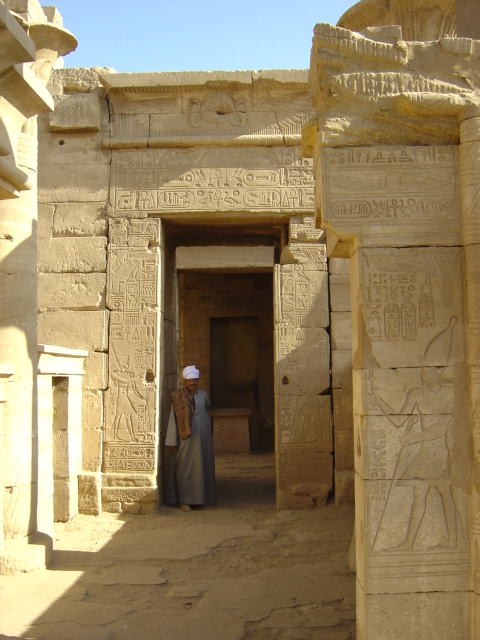
The chapel in the Temple of Ptah
The Temple of Ptah was begun under Thutmose III and extended by later rulers, including in the Ptolemaic period. It is modest next to the Amun temple: a short axis, a series of small gateways, and a set of chapels at the back.
One of those chapels belongs to Sekhmet, and she is still in it. That is the part worth understanding before you visit. Almost every major Egyptian statue you will see on a normal itinerary has been moved: into a museum, into a courtyard, onto a plinth under lights. Sekhmet Karnak has not. She stands in the room built to hold her, in the dark, in the position she was meant to occupy.
Full detail on the building and how access works is in our guide to the Sekhmet Karnak chapel at Karnak Temple.
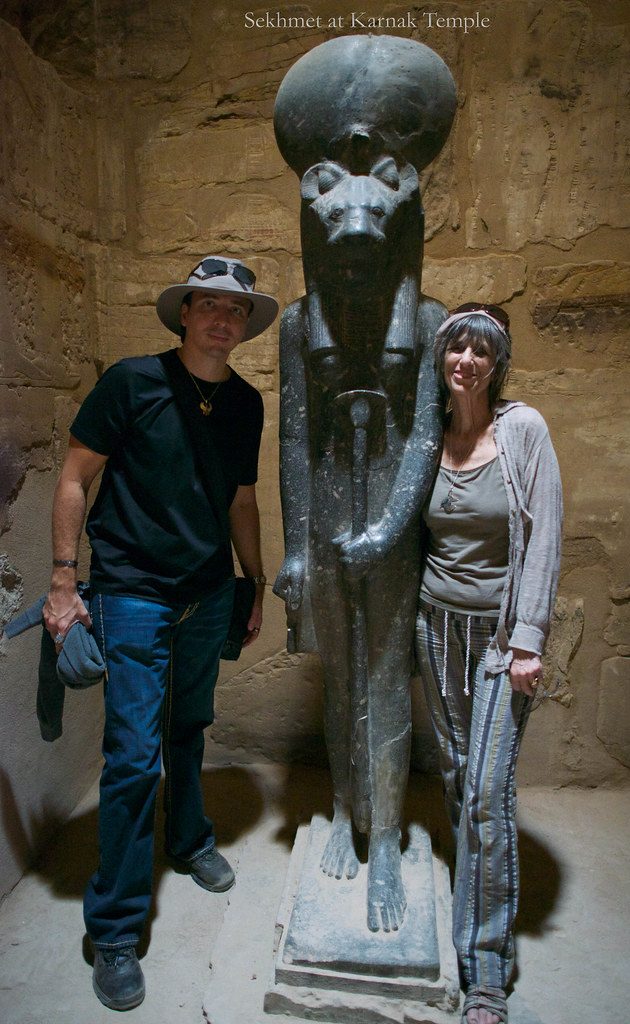
The statue itself
She is life sized and a little over, carved in dark granite, standing rather than seated, with the sun disc above her lioness head and an ankh in one hand. The stone is worn smooth in places by centuries of hands.
The chapel has no windows. Light comes through a narrow slot in the roof, and for part of the day it falls directly onto her. Walking into an unlit stone room and finding a black lioness lit from above is an experience the photographs do not prepare people for. There is more on the carving, the stone and its condition in our article on the Sekhmet statue at Karnak.
Why there were hundreds of her
Sekhmet is unusual among Egyptian deities in one respect: the sheer number of statues made of her. Amenhotep III commissioned an enormous series in the fourteenth century BC, divided between his mortuary temple on the west bank and the precinct of Mut at Karnak. The Sekhmet Karnak statues are part of this remarkable collection, with estimates of the total running into the hundreds, and figures above seven hundred are often quoted.
Nobody is certain why. The most widely repeated explanation is that they formed a kind of calendar in stone, with statues corresponding to the days of the year, so that the rituals of appeasing her could be performed continuously. It is a theory rather than a settled fact, and it is worth hearing your guide explain what the evidence actually supports.
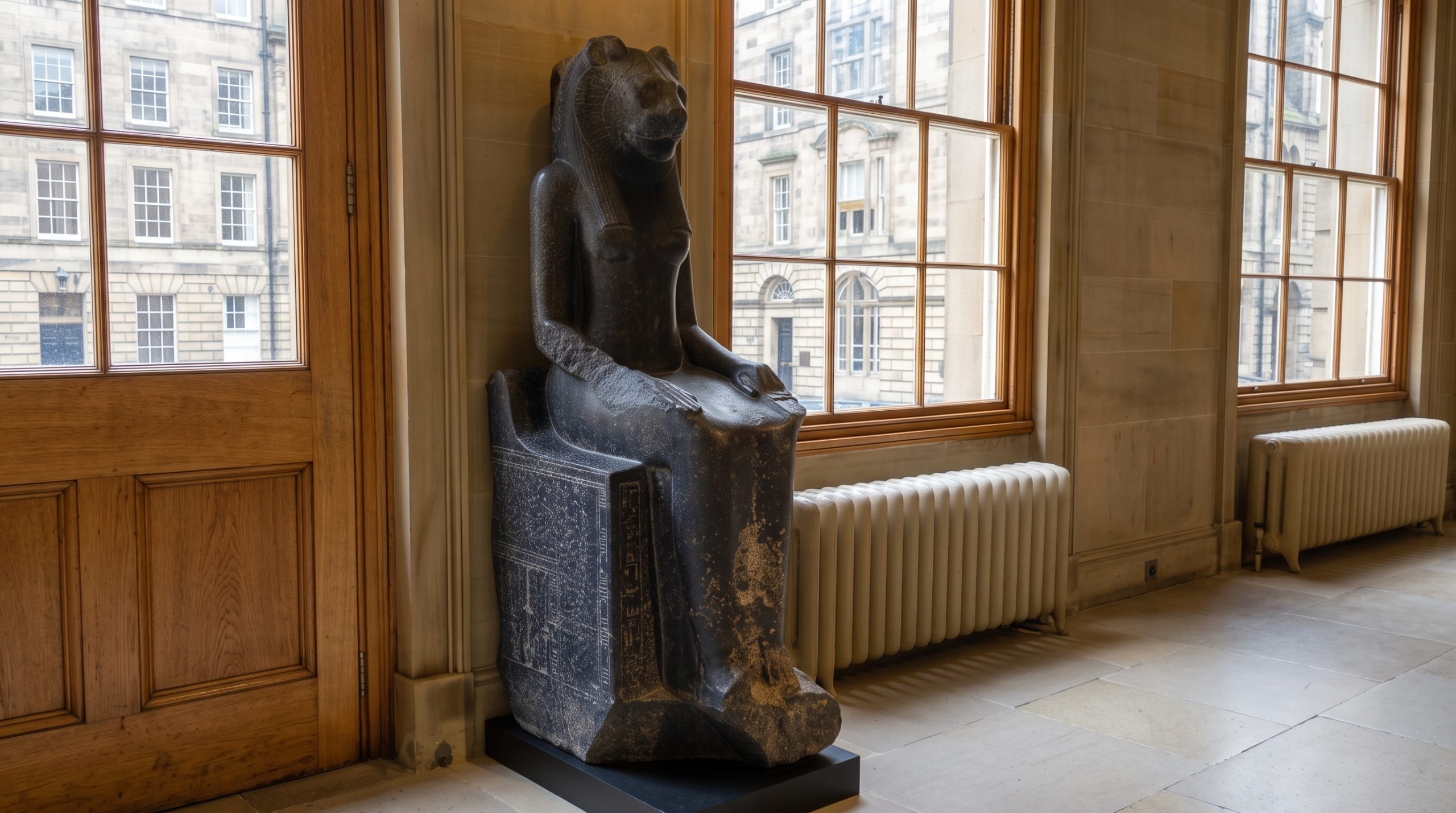
Many of those statues left Egypt in the nineteenth century and are now in museum collections across Europe and North America. The ones still in the Mut precinct, sitting in rows in the open, are among the most atmospheric things at Karnak. Seeing Sekhmet Karnak statues in their original setting offers a striking glimpse into the religious world of ancient Thebes.
The myth that explains her
Sekhmet’s reputation rests on one story. Ra, angry with humanity, sent his Eye to punish them. It took the form of Sekhmet, and she was so effective that she could not be stopped, and the world was going to end because a god had made something he could not control.
The solution involved seven thousand jars of beer dyed red. The full version, and what it tells you about how Egyptians thought about their own gods, is in the Sekhmet Karnak story.
War and healing in the same goddess
The contradiction people find hardest is that the goddess of plague was also the goddess you prayed to for a cure. That is not a contradiction in Egyptian terms. The power that sends an illness is the power that can lift it, so the sensible thing is to address that power directly. This dual nature is part of what makes Sekhmet Karnak so fascinating to visitors exploring the temple complex.
Her priests were associated with medical practice, and surviving medical texts invoke her. The Egyptian view was pragmatic: do not pretend the dangerous thing is not there, keep it appeased, and ask it for help.
It also explains the darkness of her chapel. She was not a goddess you put on display. She was a goddess you kept somewhere contained, visited deliberately, and did not annoy. The Sekhmet Karnak connection reflects this deeper side of ancient Egyptian religious belief.
Seeing her for yourself
The Temple of Ptah is inside the Karnak complex, so it needs no separate site ticket, but the Sekhmet chapel itself is not always open, and when it is, access is managed. It is a small dark room with one statue in it, which does not work as a queue.
That is what our private Sekhmet Chapel tour arranges: access with a licensed Egyptologist, and time in the chapel rather than a glance through a doorway.
Most guests combine it with the rest of the east bank. Karnak and Luxor Temple sit at either end of the Avenue of Sphinxes, and across the river the Temple of Hatshepsut holds its own chapel to a lion goddess. If you are planning the wider visit, our guide to things to do in Egypt covers how Luxor fits into a trip.
For a more experiences you can also explore our tour packages.
Standing in front of her
Karnak rewards knowing what to look for. The Hypostyle Hall is overwhelming by design, and most visitors spend their whole time inside it, photograph the columns, and leave. The small dark room at the north of the complex is the opposite kind of experience, and it is the one people tend to describe afterwards.
Sekhmet is worth the detour for a reason that has nothing to do with size. She is one of the very few major Egyptian statues still standing where she was meant to stand, in the room built to hold her, lit the way her builders intended. Everything else on a normal itinerary has been moved, relit and labelled. She has not.
Go knowing the story, and the room makes sense. Go without it, and you are looking at a statue in the dark.
Plan your visit with us
VIP Egypt Tours is operated by Travel Lovers Egypt, licensed by the Egyptian Travel Agents Association, E.T.A.A. No. 2390. We arrange private access to the Sekhmet chapel with a licensed Egyptologist, and time inside rather than a glance through a doorway.
Before you go, read the Sekhmet Karnak story for the myth that explains the chapel, the Sekhmet chapel at Karnak Temple for how to find it, and the Sekhmet statue at Karnak for the object itself.
Plan your VIP vacation, or tell us when you are in Luxor and we will build the day around her.
Follow VIP Egypt Tours
We post the parts of Egypt that do not fit in a guide like this: special access visits, what the sites look like on the day, and the history behind them.
Instagram · Facebook · YouTube
FAQ
Who is Sekhmet?
A lioness headed Egyptian goddess, daughter of Ra, associated with war, plague and healing. Her name comes from sekhem, meaning power.
Where is Sekhmet at Karnak?
In a chapel inside the Temple of Ptah, a small temple in the north of the Amun precinct, away from the main visitor route through the complex.
Can you see the Sekhmet statue at Karnak?
Yes, but the chapel is not always open and access is managed when it is. It is a small dark room holding a single statue, so visits are arranged rather than walked into.
Why is the Sekhmet chapel dark?
It was built that way. There are no windows, and light enters through a narrow slot in the roof. For part of the day that light falls directly on the statue.
Why are there so many Sekhmet statues?
Amenhotep III commissioned a very large series, split between his mortuary temple and the Mut precinct at Karnak. Estimates run into the hundreds. The most common explanation is a ritual calendar in stone, though this remains a theory.
Is Sekhmet the same as Bastet?
No. Both are feline goddesses and they are sometimes treated as two aspects of one idea, but Bastet is a cat goddess associated with protection and the home, and Sekhmet is a lioness associated with destruction and healing.
Is the Sekhmet statue at Karnak original?
It is an ancient statue standing in the chapel built for it, which is unusual. Most comparable statues were moved to museums during the nineteenth and twentieth centuries.
.